
Arc B580
Battlemage · 12 GB · 190 W · PCIe 4.0 x8
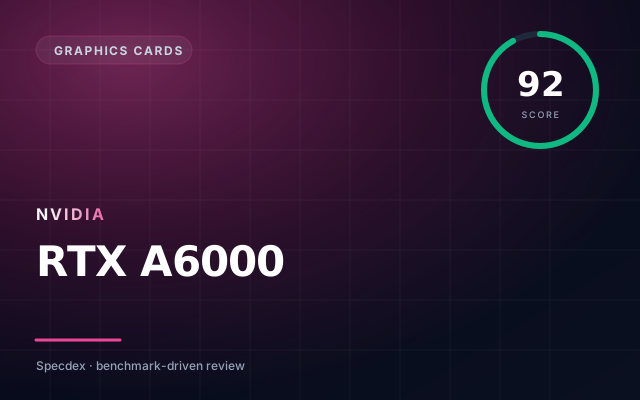
RTX A6000
Ampere · 48 GB GDDR6 ECC · 300 W
RTX A6000 takes it — here’s why.
In our weighted Specdex score, Arc B580 lands at 82 and RTX A6000 at 92. That puts RTX A6000 ahead by 10 points — a decisive margin driven mostly by its strengths in the categories below.
Pick Arc B580 if…
- ✓Incredible $/frame at 1440p
- ✓12 GB VRAM on a budget card
- ✓Modern AV1 + XeSS 2
Pick RTX A6000 if…
- ✓ECC VRAM for professional workloads
- ✓ISV certifications
- ✓Huge framebuffer
Winner by scenario
Derived from the sub-score breakdown · not a separate test4K & rasterization
RTX A6000Traditional rendering throughput at high resolution
RTX A6000 leads on raster (87 vs 82).
Ray tracing
RTX A6000RT-heavy titles with path-traced lighting
RTX A6000 leads on rt (92 vs 76).
AI workloads
RTX A6000Local inference, upscaling, generative tools
RTX A6000 leads on ai (93 vs 80).
Power efficiency
TieFrames per watt — heat, noise, and PSU sizing
Effectively tied — neither pulls a 2-point weighted lead.
Value for money
Arc B580Specdex score per dollar at MSRP
Arc B580 more score per dollar ($249 vs $4,650).
Score breakdown
Specs side-by-side
| Spec | Arc B580 | RTX A6000 |
|---|---|---|
| Architecture | Xe2 Battlemage | Ampere |
| Xe cores | 20 | — |
| Ray Tracing Units | 20 | — |
| XMX engines | 160 | — |
| VRAM | 12 GB GDDR6 | ▲ 48 GB GDDR6 ECC |
| Memory bus | 192-bit | — |
| Bandwidth | 456 GB/s | — |
| Base clock | 1.70 GHz | — |
| Boost clock | 2.67 GHz | — |
| TBP | 190 W | 300 W |
| PCIe | PCIe 4.0 x8 | — |
| Release year | — | 2020 |
Arc B580
- +Incredible $/frame at 1440p
- +12 GB VRAM on a budget card
- +Modern AV1 + XeSS 2
- −PCIe 4.0 x8 interface (not x16) — bottlenecks on PCIe 3.0 boards
- −Older DX11 titles can still struggle
- −Needs resizable BAR
RTX A6000
- +ECC VRAM for professional workloads
- +ISV certifications
- +Huge framebuffer
- −Expensive per-frame vs consumer
- −Lower gaming clocks
- −Driver optimized for CAD/DCC not games
FAQ: Arc B580 vs RTX A6000
Which is better, Arc B580 or RTX A6000? +
RTX A6000 scores 92 on our weighted rubric — ahead by 10. Your best pick depends on the sub-scores above.
Is Arc B580 worth the price? +
At $249, Arc B580 delivers a Specdex score of 82 — strongest in efficiency.
Is RTX A6000 worth the price? +
At $4,650, RTX A6000 delivers a Specdex score of 92 — strongest in ai.
Does Arc B580 or RTX A6000 last longer? +
Based on our long-term update and support ratings, both ship with multi-year support. Battery and reliability scores are visible in the breakdown above.
Which is better for 4K gaming, Arc B580 or RTX A6000? +
RTX A6000 — leads on raster (87 vs 82). Traditional rendering throughput at high resolution.
Which is better for ray tracing, Arc B580 or RTX A6000? +
RTX A6000 — leads on rt (92 vs 76). RT-heavy titles with path-traced lighting.